Squirrel Away – Subitizing Game for Structuring Numbers (1-6)

“Can we play again?”

This is an awesome game I use to help teach spatial patterns and subitizing while working on structuring numbers with my first-grade math intervention group. They love it! This is the 1-6 version. The 7-12 version will be coming soon.

Goals of the lesson
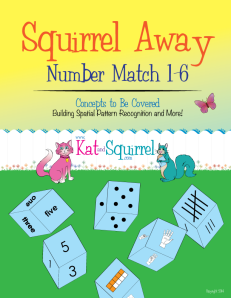
Squirrel Away Number Match 1-6 Game from Kat and SquirrelCCSS.Math.Content.K.CC.A.1
Count to 100 by ones and by tens.

CCSS.Math.Content.K.CC.B.4
Understand the relationship between numbers and quantities; connect counting to cardinality.

CCSS.Math.Content.K.CC.B.5
Count to answer “how many?” questions about as many as 20 things arranged in a line, a
rectangular array, or a circle, or as many as 10 things in a scattered configuration; given a
number from 1-20, count out that many objects.

CCSS.Math.Content.1.NBT.A.1
Count to 120, starting at any number less than 120. In this range, read and write numerals
and represent a number of objects with a written numeral.

Get the Game from Kat and Squirrel


Click here to check our Squirrel Away Dice game for numbers 7-12
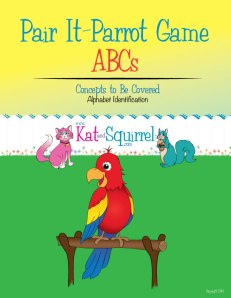
 

“Pair it” Parrot Game – ABC Recognition

This is a super fun card game that can be used to reinforce letter recognition. Great for intervention groups or centers. Includes an original Kat and Squirrel story and a bonus ABC order worksheet.

"Pair it" Parrot - ABC Recognition Game from Kat and SquirrelGoals of the lesson

CCSS.ELA-Literacy.RF.K.1.d Recognize and name all upper- and lowercase letters of the alphabet.

Get the Game from Kat and Squirrel

The Pair It Parrot games by Kat and Squirrel

Continue reading

ABC Order Scoot

ABC Order Shoot from Kat and SquirrelStudents will practice ABC order by playing a fun and active game. Alphabetical order is an essential skill for mastering the task of accessing reference material.

Goals:

CCSS.ELA-Literacy.L.2.4e Use glossaries and beginning dictionaries, both print and digital, to determine or clarify the meaning of words and phrases.

CCSS.ELA-Literacy.L.3.2g Consult reference materials, including beginning dictionaries, as needed to check and correct spellings.

CCSS.ELA-Literacy.L.3.4d Use glossaries or beginning dictionaries, both print and digital, to determine or clarify the precise meaning of key words and phrases.

Kat and Squirrel - Get the Lesson!

The Dugout Dilemma – Physical Science Unit for Second Grade

Dugout Dilemma - Physical Science Unit for Second GradeThis is an interactive story with pauses after each ‘chapter’ to allow students and teachers time to plan, investigate, research, test materials, record observations, and make conclusions.

All lessons are introduced by a continuing story about Kat and Squirrel’s goofy adventures while at baseball practice. The lessons are aligned with the Next Generation Science Standards for second grade (see next page). And the lessons have been created by an experienced elementary teacher.

The timing will depend upon how long and how often you have science class, but would most likely take 2-3 weeks. This could also be integrated into the reading/language arts curriculum very easily with a few creative teacher additions.

Goals of the lesson

NGSS Aligned

2-PS1 Matter and Its Interactions

Students who demonstrate understanding can:

2-PS1-1. Plan and conduct an investigation to describe and classify different kinds of materials by their observable properties.
[Clarification Statement: Observations could include color, texture, hardness, and flexibility. Patterns could include the similar properties that different materials share.]

2-PS1-2. Analyze data obtained from testing different materials to determine which materials have the properties that are best suited for an intended purpose.*
[Clarification Statement: Examples of properties could include, strength, flexibility, hardness, texture, and absorbency.] [Assessment Boundary: Assessment of quantitative measurements is limited to length.]

2-PS1-3. Make observations to construct an evidence-based account of how an object made of a small set of pieces can be disassembled and made into a new object. [Clarification Statement: Examples of pieces could include blocks, building bricks, or other assorted small objects.]

Kat and Squirrel - Get the Lesson!

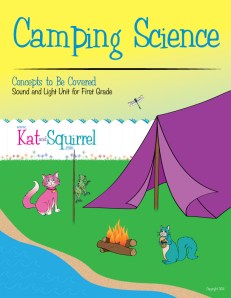
Camping Science – Sound and Light Unit for First Grade

Camping_ScienceKat and Squirrel Go Camping This is an interactive story with pauses after each ‘chapter’ to allow students and teachers time to research topics (nonfiction paired articles are included!), conduct experiments (teacher and student directions included!), do demonstrations (detailed instructions included!), discuss vocabulary (vocab. cards are included!), record observations and conclusions (recording sheets included!), and even play a fun game (rules and graphics included!). All lessons are introduced by a continuing story about Kat and Squirrel’s goofy adventures while on a camping trip. The lessons are aligned with the Next Generation Science Standards for first grade. And the lessons have been created by an experienced first-grade teacher. The timing will depend upon how long and how often you have science class, but would most likely take 2-3 weeks. This could also be integrated into the reading/language arts curriculum very easily with a few creative teacher additions.
Kat and Squirrel - Get the Lesson!

Goals of the lesson

NGSS Aligned 1-PS4 Waves and their Applications in Technologies for Information Transfer Students who demonstrate understanding can:

1-PS4-1. Plan and conduct investigations to provide evidence that vibrating materials can make sound and that sound can make materials vibrate. Clarification Statement: Examples of vibrating materials that make sound could include tuning forks and plucking a stretched string. Examples of how sound can make matter vibrate could include holding a piece of paper near a speaker making sound and holding an object near a vibrating tuning fork.

1-PS4-2. Make observations to construct an evidence-based account that objects can be seen only when illuminated. Clarification Statement: Examples of observations could include those made in a completely dark room, a pinhole box, and a video of a cave explorer with a flashlight. Illumination could be from an external light source or by an object giving off its own light.

1-PS4-3. Plan and conduct an investigation to determine the effect of placing objects made with different materials in the path of a beam of light. Clarification Statement: Examples of materials could include those that are transparent (such as clear plastic), translucent (such as wax paper), opaque (such as cardboard), and reflective (such as a mirror).

*Not included in this unit: (But wouldn’t this be a great time to do it?) You could have your students write another chapter to the story where Kat and Squirrel get separated and need to devise a way to find each other. Oooooh, the possibilities….

1-PS4-4. Use tools and materials to design and build a device that uses light or sound to solve the problem of communicating over a distance. Clarification Statement: Examples of devices could include a light source to send signals, paper cup and string “telephones,” and a pattern of drum beats.

Halloween Haunted House Party: Game – Art – Math, Reading and Vowel Lessons

Kat and Squirrel Halloween Haunted House PartyKat and Squirrel are on another adventure! Today they need to pick up the VIP guest for the Haunted House Halloween Party.

Make your Halloween Haunted House Party complete with:

The Game

The Math Lesson (Grades 1 & 2)

The Reading Lesson (Grades 1 & 2)

The Vowel Lesson (Grades 1 & 2)

The Halloween Artwork

(See details on each below)


The Game:

Kat and Squirrel PumpkinsTime for some Halloween Fun! OBJECT OF THE GAME Players must collect each of the six party guests by landing on each guest’s “home” space. The player must collect 15 pieces of candy. After completing both tasks, the player must proceed to the Haunted House at the middle of the game board to deliver the guests to the party.

Kat and Squirrel Haunted House Game


Kat and Squirrel GhostThe Math Lesson:

1st Grade Goals
Operations and Algebraic Thinking 1.OA
Represent and solve problems involving addition and subtraction.
Work with addition and subtraction equations.    
Measurement and Data 1.MD Represent and interpret data.
2nd Grade Goals
Operations and Algebraic Thinking 2.OA 
Represent and solve problems involving addition and subtraction. Add and subtract within 20.
Measurement and Data 2.MD    
Represent and interpret data.
Get-the-lesson-button


Kat and Squirrel VampireThe Reading Lesson:

1st Grade Goals
Reading Standards: Foundational Skills
Phonological Awareness Phonics and Word Recognition
2nd Grade Goals
Reading Standards: Foundational Skills
Phonics and Word Recognition

Kat and Squirrel - Get the Lesson!


Kat and Squirrel SpiderThe Vowel Lesson:

1st Grade Goals
Reading Standards: Foundational Skills
Phonological Awareness Phonics and Word Recognition
2nd Grade Goals
Reading Standards: Foundational Skills
Phonics and Word Recognition
Kat and Squirrel - Get the Lesson!

Kat and Squirrel WitchThe Artwork:

Halloween theme art for your classroom Includes: Haunted House, Pumpkin Patch, Mad Scientist’s Lab, Graveyard, Spider Web, Witches’ Wood, Vampire Cave, Pumpkins, Mad Scientist, Ghosts, Spiders, Witches, Bats, Vampires and the Grim Reaper.

Kat and Squirrel - Get the Artwork Now