Pair It! Parrot! Colors and Shapes

Goals of the lesson

Pair It Parrot Shapes and Colors - Kat and SquirrelCorrectly name shapes regardless of their orientations or overall size.

Distinguish between defining attributes (e.g., triangles are closed and three-sided) versus non-defining attributes (e.g., color, orientation, overall size)
PairItParrot_Colors-and-Shape_KatandSquirrel-c2014

Shapes included:

triangle
trapezoid
rhombus
oval
circle
square
rectangle

Get the Game from Kat and Squirrel

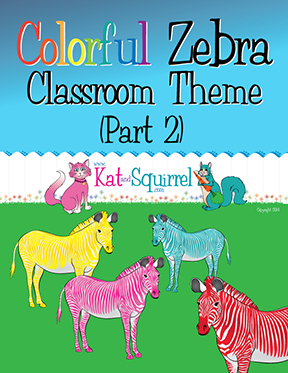
Colorful Zebra Classroom Theme Art (Part 2)

Zebra-part2-art

Materials Included:

This beautiful product contains original colorful zebra artwork to give you more of what you’ll need to set up your zebra-themed classroom.

11 pages of color-word posters that you can use to set up your
color-word word wall.
11 numeral posters (#s 0-10) which each include the numeral, written word, and a visual representation of the number.
26 letters-of-the-alphabet posters with vowels in a different color.
12 months-of-the-year headers with beautifully patterned backgrounds to fit pocket-chart calendars.
7 days-of-the-week headers to fit pocket-chart calendars.
31 numbers to fit pocket-chart calendars.
21 “special class” cards to go behind the days-of-the-week cards or the number cards.
75 “special days” cards to go behind the number cards.
Zebra_Theme-Part2-KatandSquirrel-c2014

Kat and Squirrel - Get the Artwork Now
Be sure to check out the first Colorful Zebra Classroom Theme. All artwork in this product will match the first product: http://www.teacherspayteachers.com/Product/Colorful-Zebra-Classroom-Theme-Art-1522019


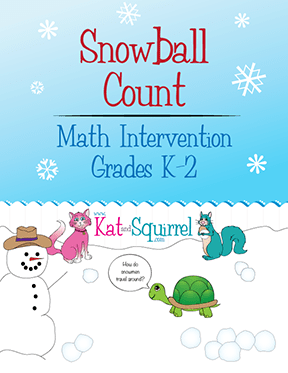
Counting Snowballs for Math Intervention K-2

Goals of the Lesson:

Snowball Count - Kat and SquirrelCCSS.Math.Content.K.CC.A.3
CCSS.Math.Content.K.CC.B.4
CCSS.Math.Content.K.CC.B.4.a
CCSS.Math.Content.K.CC.B.4.b
CCSS.Math.Content.K.CC.B.4.c
CCSS.Math.Content.K.CC.B.5
CCSS.Math.Content.1.NBT.A.1

Includes 20 printable cards with a set of snowballs to count and answers to choose from. You can use these as a counting activity in a number of creative ways.

Also included is a “back of card” to be printed on the reverse side of the snowballs, and a recording sheet.

2 Bonuses!
A Snowball Color Sheet
A Snowball Number Line

Kat and Squirrel - Get the Lesson!

Pumpkin Counting On – Math Intervention

Goals of the lesson:

Counting On with Pumpkins - Kat and SquirrelCCSS.Math.Content.K.CC.A.1
CCSS.Math.Content.K.CC.A.2
CCSS.Math.Content.K.CC.B.4
CCSS.Math.Content.K.NBT.A.1
CCSS.Math.Content.1.OA.C.6
CCSS.Math.Content.2.OA.B.2

Counting on and over a decade number has never been more fun.
Included are a variety of ways to practice counting on, self-checking pages, and a bonus – 120 chart!

Directions
Use sheet with blank third column for students to count on and fill in.
Use sheet with all columns filled in as an answer key or fold answers back for self checking.
Use sheet with blank middle column for kids to place stickers, stamps or draw “how many more” are needed to reach the total.

Pumpkin Counting On Lesson - Kat and SquirrelKat and Squirrel - Get the Lesson!

Counting Pumpkins for Math Intervention K-2

Goals of the lesson:

Pumpkin Count - KatandSquirrelCCSS.Math.Content.K.CC.A.3
CCSS.Math.Content.K.CC.B.4
CCSS.Math.Content.K.CC.B.4.a
CCSS.Math.Content.K.CC.B.4.b
CCSS.Math.Content.K.CC.B.4.c
CCSS.Math.Content.K.CC.B.5
CCSS.Math.Content.1.NBT.A.1

Includes 20 printable cards with a set of pumpkins to count and answers to choose from. You can use these as a counting activity in a number of creative ways.

Also included is a “back of card” to be printed on the reverse side of the pumpkins, and a recording sheet.

2 Bonuses!
Pumpkin Count LessonA Pumpkin Color Sheet
A Pumpkin Number Line

Kat and Squirrel - Get the Lesson!

What can Rainbow Fish teach teachers about sharing?

Rainbow Fish learned about the value of sharing by making a small gesture and deciding to share in his own time.  If the octopus would have said, “You have plenty of scales.  The little blue fish only wants one.  You’re older so be nice and share.”  I doubt Rainbow Fish would have ever felt true joy in the giving of his scales.

But the octopus was wise.  She waited until Rainbow Fish came to her.  By this time he was almost done needing the scales to feel happy.  She gave him advice, then disappeared.  She didn’t give him a time limit to comply.  She didn’t demand that he obey.  She allowed him the right to hold onto his belongings as long as he wanted.

Why did the octopus’s tactic work?  Because:

Being forced to share feels bad, but giving to someone feels good.1.  Being forced to share feels bad, but giving to someone feels good.

2.  People (and fictional fish) have the right to hold on to their things until they are ready to give them up.  (Would you hand over your house keys to anyone who wanted a turn living there?)

3.  The octopus builds trust by supporting the Rainbow Fish’s idea that the scales were important to him.

4.  Rainbow Fish learns how his actions (sharing and not sharing) affect others.

Octopus isn’t worried that Rainbow Fish will become selfish, never enjoying true friendship.  She knows that with a little more time, he’ll be ready to trade beauty for friendship.  And she’s teaching him that it’s OK to tell the other fish, “I’m still using these right now. I’ll let you know when I’m done.”

In school we expect kids to “share” many times.  Heather Shumaker, author of the book It’s OK Not to Share and Other Renegade Rules for Raising Competent and Compassionate Kids, states that,

“Young children aren’t ready to share; they are ready to take turns.  Turn-taking empowers kids and helps teach courtesy, awareness, and spontaneous generosity.”


RainbowFishChart


What does Kyle learn in this situation?

1.  Impulse control.

2.  Delayed gratification.

3.  How to handle a tough situation.

What does Dan learn?

1.  Awareness of how others feel when he keeps a favorite item.

2.  Courteousness by letting others know when they can have a turn.

3.  Assertiveness by claiming ownership of an item that is rightfully his.

Sometimes in a museum or public playground the adult will need to explain to the child that this is a place when we need to take our turn quickly so others can use things too.  By doing this you are teaching that in different contexts, different rules apply.  This is so very important for kids to learn.  They will be much more apt to “buy in” to this idea if that trust has been built in other situations.

One idea from Heather Shumaker’s book that I plan to implement in my classroom is the idea of making a “waiting list” for favorite books.  In my classroom, like many others, each child has a book box to use during Daily Five.  At times a child will find a favorite book that others also want to read (Fly Guy, just saying!).  I like the idea of creating a waiting list for the book that can be placed in the desired book as a bookmark.  Kids can add their names to the “waiting list bookmark” and cross names off as the coveted book makes its way through the list.

The kids will also need to understand that it is the decision of the book holder as to when they are done with the book.  If a book isn’t moving well I try to find more copies of the book or distract the kids with other great books to fill the wait time.

As Rainbow Fish let the other fish take turns wearing his shimmering scales, he became more and more delighted.  He finally felt at home.  And no one had to force him to share. Let’s try to encourage (not force) our students to discover the delight in giving.  The classrooms full of Rainbow Fish are sure to sparkle with joy.

Some good books for you:


10 Lessons from Storybook Characters

What can Shy Charles teach teachers about the introverted student?

Poor misunderstood Charles! He was happy as can be until others told him he wasn’t.  Let’s not do that to any of our kiddos.  Understanding children like Charles is vital for any teacher.

Introversion is often confused with shyness.  Shyness has to do with social settings where a person wants to be more involved socially, but can’t because of anxiety.  Both introverts and extroverts can be shy.  I think Charles might argue the “shy” label if he could.

The book The Hidden Gifts of the Introverted Child: Helping Your Child Thrive in an Extroverted World by Marti Olsen Laney, Psy. D  states that “Introversion is actually an inborn temperament based on (a) child’s genetic makeup.”  The book explains that most people have both introverted and extroverted proclivities, with more people on the extroverted end of the spectrum.  The main differences have to do with energy as shown in the chart below:

Energized by Depleted by
Introverts accessing thoughts, feelings, and perceptions too much activity, noise, and chatter
Extroverts lots of people and much action too much quiet or solitude


What does that mean to teachers?  Well, in order to do a better job teaching a good share of our class, we need to remember that introversion is not a personality.  It is a way that many people interact with the world.  These strategies can help you interact with and better teach an introverted child.
In order to do a better job teaching, we need to remember that introversion is not a personality. - Kat & SquirrelAn introvert is like a treasure chest.  They are full of ideas, thought, fantasies, and feelings.  A teacher can help an introverted child gain a feeling of belonging by encouraging them to open the treasure chest and share the bounty within.  Interacting with others will help them stave off feelings of isolation. Charles enjoyed building a spaceship out of chairs alone, but he also enjoyed quiet times with his family.

An introvert is like a kaleidoscope.  They can amuse themselves for hours with what seems like very little stimulation.  They connect with deeper and deeper aspects of it also making connection with their inner thoughts. Teachers can focus on depth of learning vs. breadth when they recognize students with this deep focus.  Can you imagine Charles’ colorful thoughts as he zipped along on his roller skates?

An introvert is like a library.  They are full of knowledge, always seeking more resources, and willing to share information when asked.  Teachers can recognize this love of learning and make sure the curriculum is something worth learning about. (No boring time killers!) Present information in a way that kids will recognize its importance and crave learning more.  Charles knew exactly what to do in an emergency, probably because he’d already played the scenario through in his head.

An introvert is like a jigsaw puzzle.  They focus in on different aspects of their worlds and piece them together in creative innovative ways.  Teachers can ask the class for input when solving problems in the classroom.  An introvert has probably already recognized the problem and has been tossing around ideas for a while.  Teachers can also make sure the arts are a vibrant part of the work done in class.  Including music, drawing, painting, and sculpture in class projects will give introverts creative ways to express what they are thinking.  Charles didn’t enjoy dancing ballet, but he might have enjoyed learning to play that piano.

An introvert is like a fertilized chicken egg.  They appear extremely calm and collected on the outside, but inside they are processing emotions, thoughts, and feelings like crazy.  They are very tuned in to their own feeling and the feelings of others leading them to work well in groups.  Teachers can realize that introverts feeling are hurt easily.  They can ruminate over hurt feelings for some time without demonstrating or telling their feelings. They can have emotions flare-ups if they are tired, stressed, threatened, or hungry. Charles sure did after being yelled at by his dad during football practice.

An introvert is like a BFF.  They love to hold conversations and do so with a multifaceted use of social niceties.  They are great listeners, rarely interrupt, pick up on body language, offer real advice, remember past conversations, and keep secrets well.  They have playful imaginations and are loyal to people who take time to connect with them. Teachers can make sure introverts have access to others who enjoy discussing ideas in depth.  Teachers can also make sure the introvert is not depleted by too much socializing. Mrs. Belinski is sure to be one of Charles’ favorite people in the world.  She understands that he’s not ready to show his appreciation yet, and she knows that one day he will.

An introvert is like a crew member.  They don’t need to be in the spotlight in order to feel great about themselves.  They enjoy observing and being a part of things but don’t need to be the center of attention.  Too much attention actually becomes highly uncomfortable and even painful for many introverts.  Teachers can praise introverts privately for their accomplishments (they love recognition). Make sure that in any production there are “behind the scenes” roles, and never negatively single anyone out.  Charles showed his willingness to pitch in when he got Mrs. Block a blanket, some cocoa, and called the emergency service.

An introvert is like salmon.  They can be super healthy!  With all of their inner thought going on they are conscientious and think before making poor choices.  They know it’s best to swim upstream even though it’s more difficult.  They recognize the needs of their bodies and take measures to fulfill these needs.  Teachers can make sure that introverts are given solid factual information about health because they are likely to follow through with suggestions.  Do not feed them “old wives’ tales” like, “if you swallow a watermelon seed you’ll grow one in your tummy”.  Also make sure they know where to go to get more information on their own. Charles knew what worked well for him. He understood when it was time to pretend to be asleep and when it was time to roller skate.

Oh, Charles, you’ll be all right  – as long as the others in your life learn that sometimes a HERO says ZERO!  And that’s OK.

Thirsty for more? Check out this site called Ten Things Educators Should Know About Introverted Students by Lisa Petrilli.

Wondering where you fall on the introvert/extrovert spectrum? Take this short quiz and find out.

Great teaching strategy to help engage the reluctant student: The Wingman / Sean Paris

Brainstorming for introverts (by the Squirrel): 5 Ways To Bring Out Your Introvert’s Creativity During Group Brainstorming Sessions (Plus 5 more ideas for the introverts)


Some good books for you:


10 Lessons from Storybook Characters

What can Curious George teach teachers about using curiosity?

Just like George your students (and you) were born with an instinctive curiosity.  How can teachers take advantage of this inquisitiveness to help students learn?  This is done by creating a mismatch between what students know and what they want to know.

Teachers can use inquisitiveness to help students learn by creating a mismatch between what students know and what they want to know.Start your lesson with a curiosity-based introduction.  Create that mismatch  between known and want to know early so the kids will stay with you until that curiosity is satisfied. The man with the yellow hat did this when he set his hat on the ground for George to explore.

You can do this by asking questions like these:

Have you ever wondered how you can tell if your brother or sister is sneaking into your room by using simple materials you may have lying around your home? (electricity lesson)

Wouldn’t it be great if we knew how to make a super giant pumpkin so we could have the biggest jack-o-lantern ever? (plant lesson)

There is a way for you to learn double the information in your history book in half the time you’d normally take. Would you like to be able to do that? (study skills)

The key to understanding other people is in knowing the body language that are displaying. (psychology lesson)

Have you ever wondered why hotdogs come in packages of 10 and buns come in packages of 8? (economics lesson)

If you want to make your bike the fastest in the neighborhood, physics is the answer. (physics lesson)

Have you ever wondered what it feels like to fly like a seagull, what would happen if you press random numbers on a phone, or what it would be like to hold a bright red balloon?  George has.  And he found out by following through with his curiosity.  If there is one thing we can take away from his experience it’s this: make sure your curiosity is always moving you in a healthy direction.  If it is – go for it!

We keep moving forward, opening new doors, and doing new things, because we’re curious and curiosity keeps leading us down new paths.- Walt Disney

Some Curious George for you:


10 Lessons from Storybook Characters

Colorful Zebra Classroom Theme Art

Colorful-Zebra-CompThis beautiful product contains what you’ll need to set up your zebra-themed classroom:

  • 17 pages of original artwork that you can cut out to use on bulletin
    boards or work stations
  • 9 table tents each in a different color to label desk groups, work
    stations, or centers
  • 9 “Happy Birthday” cards, each in a different color
  • 9 pages of stationary with beautifully patterned backgroundsColorful Zebra Classroom Theme Art - Kat and Squirrel
  • 18 pages of framed letterhead (9 colors in landscape and 9 colors
    in portrait) to print your own message in the middle for wall signs,
    anchor charts, or notes home
  • 9 pages of smaller framed letterhead in 9 colors to print your own
    message in the middle
  • 9 colors of intermediate desk plates to label students’ desks with
    their names or print on magnetic paper for a name sorting activity
  • 8 bookmarks with original artwork
  • 5 classroom posters: “Be Wildly Wonderful”, “We’re All Ears”,
    “What’s for Lunch?”, ” Where Do We Go After School?” and one
    with zebras waiting for your message.
  • 9 colors of primary desk plates to label students’ desks with their
    names or print on magnetic paper for a name sorting activity.Kat and Squirrel - Get the Artwork Now

Be sure to check out the second Colorful Zebra Classroom Theme. All artwork in this product will match the first product:  http://www.teacherspayteachers.com/Product/Colorful-Zebra-Classroom-Theme-Art-part-2-1606732

Pumpkin Picture Book Comprehension

Pumpkin Picture Book Comprehension Unit - KatandSquirrel.com

Create a pumpkin lap book with these pages to have some fun with comprehension this fall!

I’ve used this unit for the past 2 years and the students love – love – love it!  During our designated half-hour “intervention” time I am lucky enough to be in charge of the group of first graders who are reading above grade level.  I enjoy exposing them to new vocabulary words and comprehension skills.

Of course, what first-grade teacher doesn’t love a good seasonal project? We know that tapping into the students’ ever-evolving interests helps to keep them fully engaged.  And at this time of year the humble pumpkin stands on center stage!

Kat and Squirrel - Get the Lesson!

The following favorite pumpkin picture books can be used to engage your students while strengthening their comprehension skills: (Oh – and you can easily click the links embedded in the book titles for info. about where to purchase the books. – Don’t ya just love technology!)

Sequence

Pumpkin Pumpkin by Jeanne Titherington
From Seed to Pumpkin (Let’s-Read-and-Find-Out Science 1) by Wendy Pfeffer
The Pumpkin Book by Gail Gibbons
Pumpkin Circle: The Story of a Garden by George Levenson
Pumpkin Jack by Will Hubbell
Pumpkin Cat by Anne Mortimer
From Seed to Pumpkin (Welcome Books: How Things Grow) by Jan Kottke

Story Structure

Pumpkin Soup by Helen Cooper

Too Many Pumpkins by Linda White
Pumpkin Trouble by Jan Thomas
The Fierce Yellow Pumpkin by Margaret Wise Brown
The Stubborn Pumpkin (Hello Reader, Level 3) by Laura Geringer
Pumpkin Hill by Elizabeth Spurr

Fact and Opinion

Seed, Sprout, Pumpkin, Pie (Picture the Seasons) (National Geographic Kids) by Jill Esbaum

The Very Best Pumpkin by Mark Kimball Moulton
How Many Seeds in a Pumpkin? (Mr. Tiffin’s Classroom Series) by Margaret McNamara and G. Brian Karas
Pumpkin Day! by Nancy Elizabeth Wallace
I Like Pumpkins by Jerry Smath
The Pumpkin Fair by Eve Bunting

Compare and Contrast

The Biggest Pumpkin Ever by Steven Kroll
Strega Nona’s Harvest by Tomie de Paola

The Legend of Spookley the Square Pumpkin by Joe Troiano
Little Boo by Stephen Wunderli
The Problem with Pumpkins: A Hip & Hop Story by Barney Saltzberg

Cause and Effect

The Halloween Performance by Felicia Bond
Pumpkin Fiesta by Caryn Yacowitz

Pumpkin Town! Or, Nothing Is Better and Worse Than Pumpkins by Katie McKy
The Runaway Pumpkin by Kevin Lewis
The Pumpkin Blanket by Deborah Turney Zagwyn
Pumpkin Day, Pumpkin Night by Anne Rockwell

StoryContest14Also included:

Guided Writing (Main Idea and Details)

Award-winning Kat and Squirrel story.

(This story was the winner of the AMPL Short Story Writing Contest!)

Bonuses:

“Favorite Pumpkin Story” bar graph

2 Color Sheets to use to decorate the folders

Goals of the lesson

RL.1.1. Ask and answer questions about key details in a text.
RL.1.2. Retell stories, including key details, and demonstrate understanding of their central message or lesson.
RL.1.3. Describe characters, settings, and major events in a story, using key details.
RI.1.1. Ask and answer questions about key details in a text.
RI.1.2. Identify the main topic and retell key details of a text.
RI.1.3. Describe the connection between two individuals, events, ideas, or pieces of information in a text.
RL.1.4. Identify words and phrases in stories or poems that suggest feelings or appeal to the senses.
RL.1.5. Explain major differences between books that tell stories and books that give information, drawing on a wide reading of a range of text types.
RI.1.4. Ask and answer questions to help determine or clarify the meaning of words and phrases in a text.
RI.1.5. Know and use various text features (e.g., headings, tables of contents, glossaries, electronic menus, icons) to locate key facts or information in a text.
RI.1.6. Distinguish between information provided by pictures or other illustrations and inform

ation provided by the words in a text.
RL.1.7. Use illustrations and details in a story to describe its characters, setting, or events.
RL.1.9. Compare and contrast the adventures and experiences of characters in stories.
RI.1.7. Use the illustrations and details in a text to describe its key ideas.

RL.1.10. With prompting and support, read prose and poetry of appropriate complexity for grade 1.
RI.1.10. With prompting and support, read informational texts appropriately complex for grade 1.
RF.1.1. Demonstrate understanding of the organization and basic features of print.
RF.1.4. Read with sufficient accuracy and fluency to support comprehension.
W.1.2. Write informative/explanatory texts in which they name a topic, supply some facts about the topic, and provide some sense of closure.