ABC Around the House Lesson

Learn Your ABCs with Kat and Squirrel's ABC Around the House LessonAn original Kat and Squirrel Learning Adventure in an ABC book genre. This can be printed out or viewed electronically.

After reading the story ask the class to guess what the house-sitter found. Then use pictures of household items for each letter of the alphabet.

Teachers can use them in two ways:

1. Cut out all photos and letter cards and laminate for durability. Use as a matching challenge; match item to its beginning letter.

2. Cut on dotted line only and fold on solid line. Laminate so photo is on one side and letter is on the other. Hold up a card showing the letter. Have kids guess what might have been found at Kat’s house. Then show the picture.

Also included is a key naming the items that correspond with each letter.

Goals of the lesson

CCSS.ELA-Literacy.RF.K.1.d
Recognize and name all upper- and lowercase letters of the alphabet.
CCSS.ELA-Literacy.RF.K.3.a
Demonstrate basic knowledge of one-to-one letter-sound correspondences by producing the primary sound or many of the most frequent sounds for each consonant.
CCSS.ELA-Literacy.RF.K.3.b
Associate the long and short sounds with the common spellings (graphemes) for the five major vowels.
CCSS.ELA-Literacy.RF.1.2.c
Isolate and pronounce initial, medial vowel, and final sounds (phonemes) in spoken single-syllable words.
CCSS.ELA-Literacy.RF.1.3
Know and apply grade-level phonics and word analysis skills in decoding words.


3!!! Bonus Items:
Responding worksheet that can be easily differentiated
Compare/contrast worksheet
and
Make-Your-Own ABC cards!

Kat and Squirrel - Get the Lesson!


Some fun ABC books to increase interest and motivation for reading and writing:


Dr. Seuss’s ABC:
An Amazing
Alphabet Book!


Curious George’s ABCs


R Is for Rocket:
An ABC Book


AlphaOops!:
The Day Z Went First


B Is for Bulldozer:
A Construction ABC


Chicka Chicka
Boom Boom


LMNO Peas
(The Peas Series)


Q Is for Duck:
An Alphabet
Guessing Game


Bad Kitty


Poor Puppy
and Bad Kitty

Mystery Stop and Jot Unit – Elementary

Mystery Stop and Jot Reading Lesson from Kat and SquirrelThis way-too-fun mystery unit uses the “Stop, Think, Jot” reading strategy to delve into any mystery story.

This expanded version now includes more detailed teacher ideas and an original Kat and Squirrel Mystery Learning Adventure!

Included:
Teacher plans as suggestions to ‘how to teach’ the unit
“Detective Academy Training Manual” and completion certificate
Mystery vocabulary – 8 words
Cover sheet to create a “Detective Case File” with your pronged pocket folder
“Case File” papers used to collect jotted observations
“Stop and Jot” notes (or you can use Post-its)
2 styles of book logs
Lists of easy mystery books with Lexile numbers
Link to my Mystery Pinterest page!
Poster with ‘stop and jot’ codes
Bookmarks with ‘stop and jot’ codes are available here:
https://www.teacherspayteachers.com/
Product/Mystery-Stop-and-Jot-Bookmark-1195729


Goals of the Lesson:

CCSS.ELA-Literacy.RL.1.1
Ask and answer questions about key details in a text.
CCSS.ELA-Literacy.RL.1.2
Retell stories, including key details, and demonstrate understanding of their central message or lesson.
CCSS.ELA-Literacy.RL.1.3
Describe characters, settings, and major events in a story, using key details.
CCSS.ELA-Literacy.RL.1.6
Identify who is telling the story at various points in a text.
CCSS.ELA-Literacy.RL.1.7
Use illustrations and details in a story to describe its characters, setting, or events.
CCSS.ELA-Literacy.RL.1.10
With prompting and support, read prose and poetry of appropriate complexity for grade 1.
CCSS.ELA-Literacy.RL.2.1
Ask and answer such questions as who, what, where, when, why, and how to demonstrate understanding of key details in a text.
CCSS.ELA-Literacy.RL.2.3
Describe how characters in a story respond to major events and challenges.
CCSS.ELA-Literacy.RL.2.7
Use information gained from the illustrations and words in a print or digital text to demonstrate understanding of its characters, setting, or plot.
CCSS.ELA-Literacy.RL.2.10
By the end of the year, read and comprehend literature, including stories and poetry, in the grades 2-3 text complexity band proficiently, with scaffolding as needed at the high end of the range.
CCSS.ELA-Literacy.RL.3.1
Ask and answer questions to demonstrate understanding of a text, referring explicitly to the text as the basis for the answers.
CCSS.ELA-Literacy.RL.3.3
Describe characters in a story and explain how their actions contribute to the sequence of events
CCSS.ELA-Literacy.RL.3.4
Determine the meaning of words and phrases as they are used in a text, distinguishing literal from nonliteral language.
CCSS.ELA-Literacy.RL.3.5
Refer to parts of stories, dramas, and poems when writing or speaking about a text, using terms such as chapter, scene, and stanza; describe how each successive part builds on earlier sections.
CCSS.ELA-Literacy.RL.3.6
Distinguish their own point of view from that of the narrator or those of the characters.
CCSS.ELA-Literacy.RL.3.7
Explain how specific aspects of a text’s illustrations contribute to what is conveyed by the words in a story (e.g., create mood, emphasize aspects of a character or setting)
CCSS.ELA-Literacy.RL.3.10
By the end of the year, read and comprehend literature, including stories, dramas, and poetry, at the high end of the grades 2-3 text complexity band independently and proficiently.
CCSS.ELA-Literacy.RL.4.1
Refer to details and examples in a text when explaining what the text says explicitly and when drawing inferences from the text.
CCSS.ELA-Literacy.RL.4.3
Describe in depth a character, setting, or event in a story or drama, drawing on specific details in the text.
CCSS.ELA-Literacy.RL.4.10
By the end of the year, read and comprehend literature, including stories, dramas, and poetry, in the grades 4-5 text complexity band proficiently, with scaffolding as needed at the high end of the range.

Kat and Squirrel - Get the Lesson!


Early Elementary Science Related Mysteries:

Dot & Jabber and the Great Acorn Mystery

Dot & Jabber and the Big Bug Mystery

Dot & Jabber and the Mystery of the Missing Stream

Easy-Reading Mystery Classics:

The Case of the Hungry Stranger (I Can Read Book 2)

Nate the Great

Young Cam Jansen and the Missing Cookie

Cam Jansen: The Mystery of the Dinosaur Bones (Cam Jansen)

The Case of the Stolen Baseball Cards (Jigsaw Jones Mystery, No. 5)

Kat’s Favorite Series:

The High-Rise Private Eyes #1: The Case of the Missing Monkey (I Can Read Book 2)

The High-Rise Private Eyes #2: The Case of the Climbing Cat (I Can Read Book 2)

The High-Rise Private Eyes #3: The Case of the Puzzling Possum (I Can Read Book 2)

The High-Rise Private Eyes #4: The Case of the Troublesome Turtle

The High-Rise Private Eyes #5: The Case of the Sleepy Sloth (I Can Read Book 2)

The High-Rise Private Eyes #6: The Case of the Fidgety Fox (I Can Read Book 2)

The High-Rise Private Eyes #7: The Case of the Baffled Bear (I Can Read Book 2)

The High-Rise Private Eyes #8: The Case of the Desperate Duck (I Can Read Book 2)

Welcome Back to School Art (in 31 languages)

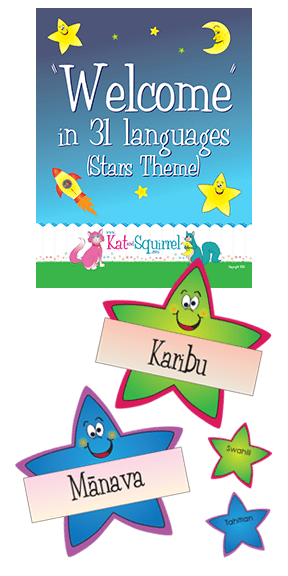
Welcome in 31 Languages Classroom Artwork from Kat and Squirrel Use this ‘star-themed’ product to welcome your students back to school in 31 languages.

Please contact us directly if you’d like a language that we haven’t included or if we have made an error in any language.

We strive for accuracy and want our products to fit your needs.

Enjoy!

If you like the star-filled artwork on this product, check out our classroom stars-themed art products for more sparkle!

Stars Classroom Theme Art (Part 1)

Stars Classroom Theme Art (Part 2)


Kat and Squirrel - Get the Artwork Now


Some books you can use to show how children are the same and different around the world:


Will You Fill My Bucket? Daily Acts of Love Around the World

Toy Stories: Photos of Children from Around the World and Their Favorite Things

Wake Up, World!: A Day in the Life of Children Around the World

Let’s Eat: What Children Eat Around the World

Wonderful Houses Around the World

Houses and Homes (Around the World Series)

What We Wear: Dressing Up Around the World

This Is the Way We Go to School: A Book About Children Around the World

My Librarian Is a Camel: How Books Are Brought to Children Around the World

Our World of Water: Children and Water Around the World

My School in the Rain Forest: How Children Attend School Around the World

Funky Flowers Classroom Theme Art

Funky Flowers Classroom Art Part 1

Kat and Squirrel Funky Flowers Classroom Theme ArtworkThis beautiful product contains what you’ll need to set up your funky flower-themed classroom:

17 pages of original artwork that you can cut out to use on bulletin boards or work stations

9 table tents each in a different color to label desk groups, work stations, or centers

9 “Happy Birthday” cards, each in a different color

9 pages of stationary with beautifully patterned backgrounds

18 pages of framed letterhead (9 landscape, in 9 colors) (9 portrait, in 9 colors) to print your own message in the middle for wall signs, anchor charts, or notes home

9 pages of smaller framed letterhead in 9 colors to print your own message in the middle

8 bookmarks with original artwork

5 classroom posters: “Bloom and Grow; Learn and Glow”, “Growing like a flower; learning by the hour.”, “Plant ideas to cultivate brilliance!”, “What’s for Lunch?”, and ” Where Do We Go After School?”

8 colors of primary desk plates to label students’ desks with their names or print on magnetic paper for a name sorting activity 8 colors of intermediate desk plates to label students’ desks with their names or print on magnetic paper for a name sorting activity

Kat and Squirrel - Get the Artwork Now


 Funky Flowers Classroom Art Part 2

Kat and Squirrel Funky Flowers Classroom Theme ArtworkThis beautiful product contains original funky flower artwork to give you more of what you’ll need to set up your funky flower-themed classroom:

11 pages of color-word posters that you can use to set up your color-word word wall.

11 numeral posters (#s 0-10) which each include the numeral, written word, and a visual representation of the number.

26 letters-of-the-alphabet posters with vowels in a different color.

12 months-of-the-year headers with beautifully patterned backgrounds to fit pocket-chart calendars.

7 days-of-the-week headers to fit pocket-chart calendars.

31 numbers to fit pocket-chart calendars.

21 “special class” cards to go behind the days-of-the-week cards or the number cards.

75 “special days” cards to go behind the number cards.

Kat and Squirrel - Get the Artwork Now

Writing Captions

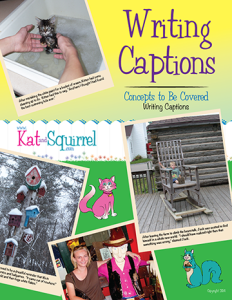
Writing Captions with Kat and  SquirrelThere are 3 lessons which employ a gradual release of responsibility approach to writing captions for photos.

Included are photos with captions for a large group lesson, photos to use to model the lesson, photos for partner work, and photos for an individual contribution to a whole-class game.

This was designed to be used in a first-grade classroom, but it could easily be used for older groups.

Story to go with the lessons:
Kat and Squirrel have been asked to fill in at the Pigeon Post
Newspaper. Their new boss, Pigeon, wants them to write captions
for the photos. They do not know how to write captions!
Can you help?

Goals of the lessons:

CCSS.ELA-Literacy.W.1.5
With guidance and support from adults, focus on a topic, respond to questions and suggestions from peers, and add details to strengthen writing as needed.

CCSS.ELA-Literacy.W.1.6
With guidance and support from adults, use a variety of digital tools to produce an publish writing, including in collaboration with peers.

CCSS.ELA-Literacy.W.1.7
Participate in shared research and writing projects (e.g., explore a number of “how-to” books on a given topic and use them to write a sequence of instructions).

CCSS.ELA-Literacy.W.1.8
With guidance and support from adults, recall information from experiences or gather information from provided sources to answer a question.


Kat and Squirrel - Get the Lesson!


Did you come up with a fun caption from the “Writing Captions” lesson? If so, write the number and your caption in the comments below. We can’t wait to read them!

Kat and Squirrel on the Farm

Life Science and Engineering Design Unit for First Grade NGSS

Kat and Squirrel on the Farm - Life Science UnitThis is an interactive story with pauses after each ‘chapter’ to allow students and teachers time to research topics (video link included!), record observations (guided viewing sheet included!), discuss thoughts supported by evidence (animal parent and offspring cards included!), and design a solution to a problem (animal adaptation cards and engineering design form included!).

All lessons are introduced by a continuing story about Kat and Squirrel’s goofy adventures while on a farm. The lessons are aligned with the Next Generation Science Standards for first grade. And the lessons have been created by an experienced first-grade teacher.

The timing will depend upon how long and how often you have science class, but would most likely take 2-3 weeks. This could also be integrated into the reading/language arts curriculum very easily with a few creative teacher additions.

Goals of the Lesson

1-LS1-1. Use materials to design a solution to a human problem by mimicking how plants and/or animals use their external parts to help them survive, grow, and meet their needs.

1-LS1-2. Read texts and use media to determine patterns in behavior of parents and offspring that help offspring survive.

1-LS3-1. Make observations to construct an evidence-based account that young plants and animals are like, but not exactly like, their parents.

K-2-ETS1-1. Ask questions, make observations, and gather information about a situation people want to change to define a simple problem that can be solved through the development of a new or improved object or tool.

K-2-ETS1-2. Develop a simple sketch, drawing, or physical model to illustrate how the shape of an object helps it function as needed to solve a given problem. Optional: If you have your students build their “solutions,” it would be a great time to complete this standard:

K-2-ETS1-3. Analyze data from tests of two objects designed to solve the same problem to compare the strengths and weaknesses of how each performs.

Optional: If you have your students build their “solutions,” it would be a great time to complete this standard: K-2-ETS1-3. Analyze data from tests of two objects designed to solve the same problem to compare the strengths and weaknesses of how each performs.


Kat and Squirrel - Get the Lesson!

Recommended Reading for Help with Homework

Looking for more help with your homework? The Kat recommends the following books:

Homework: A Parent’s Guide To Helping Out Without Freaking Out!

How to Do Homework Without Throwing Up (Laugh & Learn)

Homework Made Simple: Tips, Tools, and Solutions to Stress-Free Homework

John Rosemond’s Fail-Safe Formula for Helping Your Child Succeed in School

The New Six-Point Plan for Raising Happy, Healthy Children: A Newly Updated, Greatly Expanded Version of the Parenting Classic (Backlist eBook Program)


Ending the Homework Hassle

Smart but Scattered Teens: The “Executive Skills” Program for Helping Teens Reach Their Potential

Smart but Scattered: The Revolutionary “Executive Skills” Approach to Helping Kids Reach Their Potential

Free Homework Help Take Home

Supporting Your Child’s Schoolwork from Home

Get the schoolwork done and keep your sanity? Yes it is possible.  Use these tips to create an independent learner out of your child.

Free Homework Help Take HomeEarly Elementary

In the early elementary years much of the homework requires an adult’s assistance. You will be helping your child read, journal, practice spelling words and math facts, and helping them read and understand math story problems. Homework in this stage is usually best if completed in 10-30 minutes.

Late Elementary/Early Middle School

In late elementary or early middle school you can expect to help your child keep to their study schedule as well as assist with tracking projects and tests on a calendar. Encourage them to make good use of an assignment notebook by writing down assignments as soon as they are given. Much of the actual work will be independent now, but be ready to assist if your child needs help. You might suggest different approaches to study the material, but don’t push. Homework in this stage is usually best if completed in 30-60 minutes.

Middle School/Early High School

In late middle school to early high school you’ll find yourself decreasing your support even more. Monitor your child and determine if he or she is able to succeed independently. If so, great! Keep monitoring. If not, be ready for your child to experience some natural consequences like not feeling prepared for class or even a bad grade or two. Don’t worry; it’s those natural consequences that are teaching your child how to gain independence. Add support back into the homework routine until things get back on track then gradually fade support once again. Homework in this stage is usually best if completed in 60-90 minutes.

Late High School/College

In late high school and college maintain an interest in what your child is learning and help them to study if they ask. Inquire about projects and upcoming tests in a friendly manner. Let them know that you trust them to be independent by giving them the freedom to study on their own. Homework in this stage is usually best completed in 2 hours per class per week (or more in college).


Then sit back and have a cool glass of lemonade. You’ve created an independent learner!

Lemonade-glass

Homework First Aid for Parents

Is homework giving you headaches? Is study time stressing you out? If so, you and your child may be in need of a little homework first aid. Read and follow these prescriptions for fast relief.

Homework PrescriptionEnvironment – Create a calm, quiet, and comfortable environment for your child to study. The ideal location would be a special place set aside for studying only. Preferably not near a window, TV, or other visual distractions.   Locate necessary supplies like pencils, pencil sharpeners, paper, dictionary, flash cards, calculator, calendar, etc. within arm’s reach of the study area. Sitting on a yoga ball may benefit active kids by allowing them to move.


Homework Prescription

Preparation – Try to have your child study at the same time every day so the work becomes routine and habitual. This could be right after school, or after some play time. Make sure it is a time when your child still has energy. Schedule a snack and bathroom break just before settling in to study.


Homework PrescriptionPriorities – Work on the hardest project first. You know your child’s strengths and weaknesses and can use this to your advantage by doing the difficult work when your child has the most energy. Make sure to praise real effort along the way. Use a calendar to keep track of large projects and tests. This will help you plan the best use of your study time. Create a to-do list on a small white board and let your child erase each activity as you complete it.


Homework Prescription

Methods – Study methods will depend upon your child’s age and the type of material being learned. Some tried and true study methods include using manipulatives, using flashcards, highlighting important material, creating a graphic organizer, reading aloud, turning information into a rap or song, playing a game with your material, creating simulations, generating a mnemonic, and reteaching the material to someone else.


Homework PrescriptionBreaks – Depending on your child’s age and study load, you may want to schedule some ‘brain breaks’ every 10-20 minutes. Brain breaks are 1-3 minutes of physical activity designed to help your child reenergize and regain focus. A brain break could include dancing, jumping, running, or anything you can think of that’s fun and gets the body moving.


Free Homework Help Take Home


Dosage: Be sure to take all 5 prescriptions in a caring environment daily.

Side effects may include (but are not limited to): happy, calm, smart, loving, generous, and beautiful children.