What can Skippyjon Jones teach teachers about imagination?

Imagine yourself as the person you want to be.“Imagination is the true magic carpet.” Norman Vincent Peale

Hola, Amigos! You will never believe what just happened to me!  As I was jumping on my bed I crossed in front of the mirror, and I saw Super Teacher!  I could not let this happy happening go to waste so I scampered (Super Teachers do that right?) over to my closet and was transformed to the wonderful world of my classroom.  It was dark… and scary, but I had no fear with my trusty light saber at my side. (It’s my adventure, I’ll have a light saber if I want to. Por Favor?)

I heard small shuffling noises from the reading corner. From the glow given off by said trusty light saber I was able to find the light switch and turn it on.   To my delight and surprise I saw my old amigos (students) Mary Always Goodgirl (the smallest of the small ones), David Everright, Alivia Alorganized, and Helpy McHelperson (the biggest of the small ones).  They ran to me saying, “Super Teacher, we are so glad you are here.” (in a perfectly complete sentence, I might add) They told me about the terrible Parachutito that came into the classroom (while they were dutifully working on their math and staying seated at their desks) and stole all of our counting frijoles. “Not our counting beans!,” I said. “Por que?”

They did not know. But they were sure they saw him heading to the gymnasium.  “Vamonos!” I said, and we sang a song as we hustled to the gym.

Oh, we are all in a stupor, (clap, clap)

Parachutito made a big blooper, (clap, clap)

With light saber in hand,

Our beans we’ll demand,

Good thing our teacher is Super! (clap, clap)

(Hey, I said it before, and I’ll say it again.  It’s MY adventure!)

We entered the gym and saw the mucho largo Parachutito.  Super Teacher (that’s me, remember) swung the light saber and blinded Parachutito for just long enough for the small amigos to each grab an edge and shake.  Soon all the frijoles were free from his evil clutches and Parachutito was lying limp and exhausted on the ground.

“Ole!” we all shouted, gathered the beans, and triumphantly marched back to our classroom.  As we entered the room I saw a strange light and fell to the floor of my closet nearly hitting my cabeza, dude.  Come to think of it, maybe I did hit my cabeza, dude!

Don’t worry, I’ve come to my senses.  And I discovered a wonderful bit of information.  Fake it until you make it really works. http://www.psychologytoday.com/blog/extreme-fear/201303/how-real-life-change-happens

Skippyjon Jones imagines himself as a brave sword-fighting chihauhau – and he really turns into one. (Really-he does!)  Imagine yourself as the person you want to be a.k.a. Super Teacher.  When faced with a problem, don’t ask yourself what you would do, ask yourself what Super Teacher would do.  Then do it.      WWSD – I can see the bracelets now, dude.

Let your imagination go wild!

http://www.jrimagination.com/blog/2012/3/13/advice-from-outside-the-box.html

Some Skippyjon Jones Books:


Some other good books for you:
  

10 Lessons from Storybook Characters

What can Alexander (the one who had the terrible, horrible, no good, very bad day) teach teachers about keeping your moods in check?

When you find yourself starting the day in a bad mood there are some things you can do.Have you even woken up with metaphorical gum in your hair?  Sometimes you just know the moment that alarm rings that it is going to be a bad day.  What is it? Not enough sleep? Hormones? Real gum in your hair?  Whatever the cause, it happens, and as a teacher you cannot let your funk get in the way of kids learning.

When you find yourself starting the day in a bad mood there are some things you can do.  First off, if this happens to you often – see a doctor.  There may be a medical condition at play here.  Secondly, if you know your foul mood is from a lack of sleep – vow to get more sleep.  Sleep deprivation can really mess up a normally sunny disposition.

Let’s say those two scenarios have nothing to do with your dismal state of mind. Don’t worry, here are some tried and true mood lifters for you to try:


1. Force yourself to smile
– seriously.  Even if you tripped on a skateboard and dropped your sweater in the sink.  Studies have shown that smiling produces a feeling of happiness within your body.  Check out the work of Paul Ekman if you don’t believe me. http://www.nytimes.com/1993/10/26/science/one-smile-only-one-can-lift-a-mood.html

2. Listen to music – The benefits of listening to music abound.  There’s a reason the dentist plays music in the patient rooms.  It can distract you and keep you calm.  There’s also a reason the high school band plays music before the big game. It can rev you up and get you ready for action.  So, pick the mood your shooting for and crank up the tunes.  Sing along for even better results. Don’t worry it you can’t carry a tune in a Cindy tote. If Alexander can count without a 16 (who needs 16?), then you can sing any way you want. I’ll take mine in P!nk. http://www.webmd.com/mental-health/news/20031022/music-improves-mood

3.  Do something kind for someone – Just because you didn’t find a toy in your cereal box this morning doesn’t mean that you can’t give to others.  Even an act as small as thanking someone, washing someone’s coffee mug, or opening a door for someone has been proven to elevate your mood.  If you really need a pick-me-up you can always do my recess duty for me, really, I’ll let you! http://drjohnhealthalert.blogspot.com/2012/01/acts-of-kindness-mood.html

4. Exercise – Your body will release endorphins, adrenaline, serotonin and dopamine and you’ll feel better.  You don’t have to have brand new shoes with colorful stripes  those plain boring white ones will do just fine. Hop into those workout clothes and start moving that beautiful body. http://longevity.about.com/od/lifelongfitness/a/exercise_mood.htm

5. Get a good laugh – It’s hard to laugh with soap in your eye, but the stung goes away eventually. And laughter is known to help your body release serotonin which makes you feel more content.  My son installed the app iFunny on my ipad mini and when I need a good laugh, it’s the first place I go for a quick fix.  If you are in the mood for a longer laugh, check out Kid Snippets on YouTube. http://www.youtube.com/playlist?list=PLDFD0284A5DA24371   “Math Class” is my all time favorite. There is no way I’m in a bad mood after watching that – I can so relate!

6. Play with your cat (or dog, if you must) – Even if you become someone’s third best friend you’ll always find unconditional love in your furry friends.  Playing with your pets releases all those feel-good hormones in your brain and lowers the stress hormone cortisol.  Pets get you moving too. Just try to forgive and forget those little hairballs “presents” that they leave for you once in a while. Oh yes, they are worth the trouble aren’t they? http://www.webmd.com/depression/features/pets-depression

So please don’t feel that you need to move to Australia in order to escape your bad mood.  Just try some of these activities first, please.  We need our wonderful teachers here!

Some Alexander Books for you:


10 Lessons from Storybook Characters

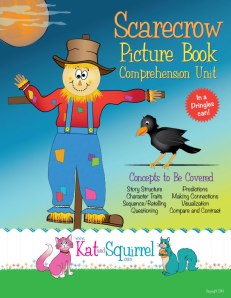
Comprehension Unit – Scarecrow Picture Books

Concepts to Be Covered

Scarecrow Picture Book Comprehension Unit from Kat and SquirrelFeaturing the following picture books:
Six Crows by Leo Lionni (Story Structure)
Scarecrowby Cynthia Rylant (Character Traits)
The Scarecrow’s Hatby Ken Brown (Sequence/Retelling)
The Little Scarecrow Boy by Margaret Wise Brown (Questioning)
The Little Old Lady Who Was Not Afraid of Anything by Linda Williams (Predictions)
Barn Dance! (Reading Rainbow) By Bill Martin Jr. (Making Connections)
The Scarecrow’s Dance by Jane Yolen (Visualization)
The Lonely Scarecrow by Tim Preston (Compare and Contrast)

Goals of the lesson

CCSS.ELA-Literacy.RL.K.1 With prompting and support, ask and answer questions about key details in a text.

CCSS.ELA-Literacy.RL.K.2 With prompting and support, retell familiar stories, including key details.

CCSS.ELA-Literacy.RL.K.3 With prompting and support, identify characters, settings, and major events in a story.

CCSS.ELA-Literacy.RL.K.9 With prompting and support, compare and contrast the adventures and experiences of characters in familiar stories.

CCSS.ELA-Literacy.RL.K.10 Actively engage in group reading activities with purpose and understanding.

CCSS.ELA-Literacy.RL.1.1 Ask and answer questions about key details in a text.

CCSS.ELA-Literacy.RL.1.2 Retell stories, including key details, and demonstrate understanding of their central message or lesson.

CCSS.ELA-Literacy.RL.1.3 Describe characters, settings, and major events in a story, using key details.

CCSS.ELA-Literacy.RL.1.4 Identify words and phrases in stories or poems that suggest feelings or appeal to the senses.

CCSS.ELA-Literacy.RL.1.5 Explain major differences between books that tell stories and books that give information, drawing on a wide reading of a range of text types.

CCSS.ELA-Literacy.RL.1.6 Identify who is telling the story at various points in a text.

CCSS.ELA-Literacy.RL.1.7 Use illustrations and details in a story to describe its characters, setting, or events.

CCSS.ELA-Literacy.RL.1.9 Compare and contrast the adventures and experiences of characters in stories.

CCSS.ELA-Literacy.RL.1.10 With prompting and support, read prose and poetry of appropriate complexity for grade

CCSS.ELA-Literacy.RL.2.1 Ask and answer such questions as who, what, where, when, why, and how to demonstrate understanding of key details in a text.

CCSS.ELA-Literacy.RL.2.3 Describe how characters in a story respond to major events and challenges.

CCSS.ELA-Literacy.RL.2.5 Describe the overall structure of a story, including describing how the beginning introduces the story and the ending concludes the action.

CCSS.ELA-Literacy.RL.2.7 Use information gained from the illustrations and words in a print or digital text to demonstrate understanding of its characters, setting, or plot.

Kat and Squirrel - Get the Lesson!

What can Junie B. Jones teach teachers about self discipline balanced with impulsivity/distractibility?

What can Junie B. Jones teach teachers about self discipline balanced with impulsivity/distractibility?

Junie B.’s new lunch box is right under her desk.  She knows she’s not supposed to keep sneaking looks at it, but her teacher’s not watching – just one more time…… Busted!

At the school’s Secret Santa Shop Junie B. has money to buy Christmas presents and ends up spending most of it on………………herself!

As teachers, we have all had to become self disciplined in some aspects of our lives, like studying for college exams, giving up a trip to the beach because we have to work, and not eating more than our share of the doughnuts in the staff lounge.  If you are anything like me you can identify some areas you’d still like to improve upon.  Mine include completing next week’s lesson plans mid week so I don’t have to stay late on Friday (which I do, more often than not) and eliminating time wasting activities from my prep time (never, never, never enough time).

Self discipline can be a great thing………….. especially for this cat:

Teaching Lesson:  Practice self discipline, but don’t sacrifice spontaneity, flexibility, friendliness, openness, and creativity.But ……once in a while ……you do need to sneak a peek at your new lunch bag and even spend a little money on (gasp!) yourself!

That’s right, self discipline is great but ONLY for the right reasons.  Spontaneity, flexibility, friendliness openness, and creativity also have a big place in the life of a successful teacher.

When you’re teaching a lesson, don’t power through it even if you know the class is lost.  A super self-disciplined teacher would finish that lesson and cross it off the lesson plans. Not cool. A teacher who gets “distracted” learns to recognize the signs from the class that say STOP – FIND THE PROBLEM – SWITCH GEARS.  You can teach the lesson, but if the students aren’t learning it, what good is it?  Junie B.’s teacher Mr. Scary realized this when he allowed her the time to show her prized lunch box to the class.

Many times I have found myself in the position of completing the hard work, not because I “should” but because I know there is a benefit to my self discipline. Like if I spend a little time each day organizing my files (ugh!) then I will be able to find what I need faster.  What is most important is having the ability to chose when to persevere and when to be impulsive.  We need both tools in our teacher toolbox.

Even June B came around when she forced herself to give May (of all people) the Christmas gift she bought for herself.  Way to go, girl!

For further information read this:
http://www.alfiekohn.org/teaching/selfdiscipline.htm

Some Junie B. Jones books:


This is blog is part of the 10 Teaching Lessons from Favorite Storybook Characters from Kat and Squirrel